
Following reports of Ayatollah Ali Khamenei's death, widespread protests erupted in Kashmir, with demonstrators expressing strong anti-US and anti-Israel sentiments.

Thousands of mourners and international delegates gathered as Iran paid its final respects to its late supreme leader Ayatollah Ali Khamenei, who was killed in an Israeli strike on February 28, in Tehran.

PDP president Mehbooba Mufti has received an official invitation to attend the state funeral of Iran's slain supreme leader Ayatollah Ali Khamenei in Tehran. She will travel to Iran as a distinguished guest of India to pay her final respects, highlighting the historical and strategic ties between the two nations.

A high-level Indian delegation, including Bihar Governor Lt Gen (Retd) Syed Ata Hasnain and Minister of State for External Affairs Pabitra Margherita, paid tributes to the assassinated Iranian supreme leader Ayatollah Ali Khamenei in Tehran, conveying India's condolences.

In the central Iranian city of Isfahan, residents gathered at Imam Square to protest the strikes and to mourn what state media termed the martyrdom of Ayatollah Khamenei. Demonstrators raised slogans including "God is great" as the airstrikes continued.

Iran's Foreign Minister Seyed Abbas Araghchi on Sunday issued a formal address and said that the event is a moment of profound religious and historical consequence.

Iran is observing 40 days of public mourning following the death of Ayatollah Ali Khamenei, Reuters reported, citing Iranian state media.

The representative of Iran's Supreme Leader in India expressed gratitude towards Indians, calling India a land of 'loyalty and humanity'.

India has expressed condolences over the death of Iran's Supreme Leader Ayatollah Ali Khamenei following a joint US-Israel strike, amidst rising tensions in West Asia and criticism over the sinking of an Iranian warship.

Iranian Supreme Leader Ayatollah Ali Khamenei has been killed in a US-Israeli attack, sparking celebrations in Iran and raising questions about the future of the regime.
A senior Iranian official has stated that Iran has not yet elected a successor to Supreme Leader Ayatollah Syed Ali Khamenei, following his assassination. The process to elect a new leader is underway, with several candidates being considered.

Protests erupted in Kashmir following the killing of Iran's Supreme Leader Ayatollah Ali Khamenei, leading to restrictions on movement and mobile internet speeds.

India is navigating a complex diplomatic landscape, attempting to balance its 'forever honeymoon' with the Israel-UAE-Bahrain axis against its historical ties with Iran, as evidenced by recent high-level visits and evolving geopolitical realignments in the Middle East, observes Ambassador M K Bhadrakumar.

For years, these two powers operated as "frenemies" in the shadow of Iran's regional influence. The frame here is "The Enemy of My Enemy."

If the Iranian regime needs to be punished for promoting quasi-terrorist outfits like Hezbollah and Hamas, then what about Pakistan which has spent decades exporting terror around the world, killing thousands, particularly in Afghanistan and India? asks M R Narayan Swamy.

Expanding the scope of hostilities, Zayed Port in Abu Dhabi, United Arab Emirates, was also targeted by missile strikes launched by Iran, according to a report by the Iranian state broadcaster, Press TV.

Congress leader Shashi Tharoor is urging the Indian government to take a more proactive role in mediating the escalating conflict between the US-Israel alliance and Iran, emphasising the impact on India's energy security and regional stability.

The assassination of Ali Larijani, Iran's top security official, in an alleged Israeli strike has sent shockwaves through the region, prompting vows of revenge and raising concerns about escalating tensions.
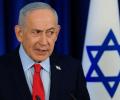
Benjamin Netanyahu declares that the joint Israel-US campaign is successfully 'crushing' Iran, eliminating existential threats and weakening the regime's regional influence.

...is a way out, notes Prem Panicker in his must read blog on the Iran War. What the indefinite extension produces is a prolonged condition of not-war-not-peace, in which oil markets cannot stabilise, Asian refineries cannot plan, European governments cannot stop subsidising consumption they cannot afford, and the next flashpoint -- a seized tanker, a miscalculated drone strike, a Truth Social post that claims too much -- is one news cycle away.

The clock on the ceasefire is running out. But everyone's already whispering about round two, possibly as soon as this weekend.

Trump may strike. He may announce productive talks and extend again. He may do both at the same time. Iran will not open the Strait on someone else's terms, so no matter what happens, that problem will remain unsolved. And the IRGC will still be collecting its $2 million toll from every ship bold enough to ask permission to pass.

The question is no longer whether the war will expand. It has. The next few days will tell us whether the war stabilises around Hormuz or whether the Strait itself becomes the trigger for a far larger rupture. What to watch for over the next 48 hours is simple: Any move by the US toward direct naval control of the Strait; any credible Iranian attempt to disrupt or mine shipping lanes and, critically, whether energy infrastructure in the Gulf continues to be targeted.If those lines are crossed in tandem, the war will no longer be containable within the region.

The LPG squeeze on India's restaurant sector is the quotidian face of a deeper crisis.

Will rising tensions between US-Israel and Iran threaten crude oil supply through the Strait of Hormuz, putting India's fuel prices, imports, and economic stability at risk?

Thousands of mourners on Saturday joined the formal funeral procession for Iranian Major-General Qassem Soleimani, the head of Islamic Revolutionary Guard Corps' Quds Force, who was killed a day before near Baghdad's international airport in an air strike ordered by United States President Donald Trump.

General Soleimani headed the Islamic Revolutionary Guard Corps's Quds Force and also served as Iran's pointman on Iraq.

Shocks were also felt in Pakistan, Lebanon, Kuwait and Turkey, news agencies in those countries reported.

Saudi Arabia has severed diplomatic ties with Iran following attacks on the kingdom's embassy and consulate in the Islamic Republic over the execution of a Shiite cleric.
